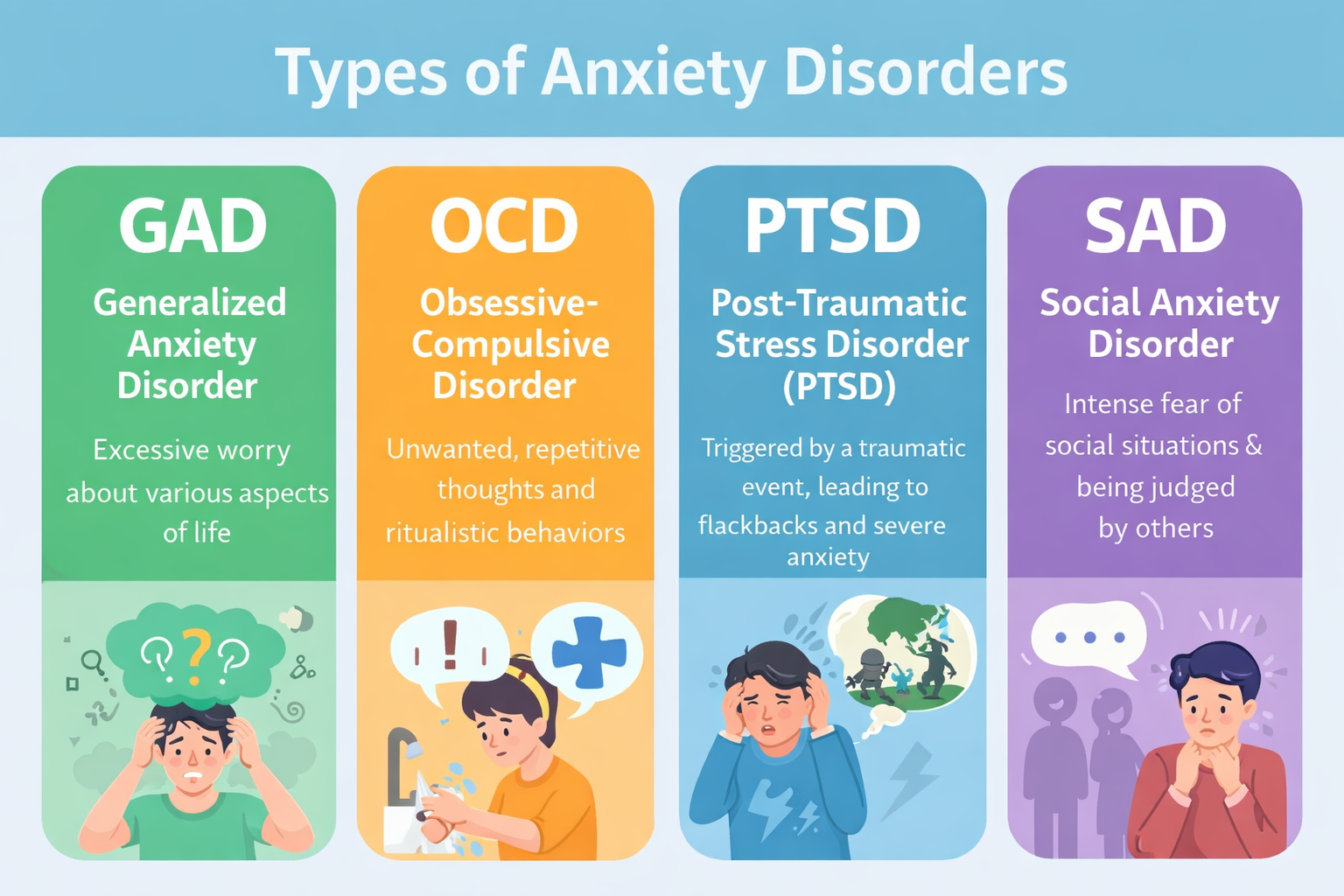
Among the many psychological disorders associated with anxiety, the four most common are GAD, OCD, PTSD, and SAD (Pine, Rothbaum, & Ressler, 2015). Each has unique characteristics, triggers, and presentations — yet all share the common thread of excessive fear and worry that disrupts daily functioning.
Disorder 01
Generalized Anxiety Disorder (GAD)
The term Generalized Anxiety Disorder first appeared in 1980, previously known as "free-flowing anxiety" by Sigmund Freud. GAD is a long-term mental disorder marked by excessive and uncontrollable worry that is not limited to specific situations. It involves both physical and psychological symptoms and is among the most common mental disorders (Guglielmo, Janiri, & Pozzi, 2014).
(Canadian Psychological Association, 2021)
Common Symptoms of GAD
- A sense of overwhelming and persistent worry
- Constant fatigue and exhaustion
- Difficulty concentrating or focusing
- Shortness of breath
- Sleep problems and insomnia
- In severe cases — symptoms resembling a heart attack
How GAD Can Escalate
If left untreated, GAD can lead to other mental health issues such as social anxiety, panic disorder, and depression. It may also increase the risk of physical illnesses including heart disease, diabetes, and cancer (Canadian Psychological Association, 2021).
| Severity | Work Life | Family Life | Social Life |
|---|---|---|---|
| Mild | Minor distractions | Occasional tension | Some avoidance |
| Moderate | Reduced productivity | Increased conflict | Withdrawal |
| Severe (merged example) | Unable to function effectively | Near-complete isolation | |
Disorder 02
Obsessive-Compulsive Disorder (OCD)
OCD was traditionally classified as a neurotic disorder. Today, it is recognized as an anxiety-related disorder characterized by recurring obsessive intrusive thoughts and repetitive behaviors. These ritualistic actions — such as excessive hand-washing — are performed to reduce anxiety (Rachman & De Silva, 2009).
"Individuals with OCD feel driven to perform repetitive behaviours, even though they recognize that these actions are irrational or excessive." — Rachman & De Silva, 2009
Key Features of OCD
- Obsessions — unwanted, recurring intrusive thoughts or images
- Compulsions — repetitive behaviors performed to neutralize the distress
- Cycle — obsessions trigger anxiety → compulsions provide temporary relief → cycle repeats
- Awareness — individuals often know their behaviors are irrational but feel unable to stop
(Ahmari & Rauch, 2022)
Disorder 03
Posttraumatic Stress Disorder (PTSD)
Post-traumatic stress disorder (PTSD) is a mental health condition that can develop after a person is exposed to a dangerous or traumatic event. It is an anxiety-related disorder that can affect all aspects of a person's life (Muscari, 2012).
Although PTSD is most commonly associated with military personnel after going through combat, this condition can affect anyone who experiences a difficult event that goes beyond normal human experience — including sexual abuse or natural disasters.
Who Can Develop PTSD?
- Military veterans and combat survivors
- Survivors of sexual or physical abuse
- People who have lived through natural disasters
- Witnesses of violent events
- First responders and emergency workers
Anxiety problems often begin after a person goes through a traumatic or upsetting life event. In people with panic disorder, these events often occur within six months before symptoms begin.
Disorder 04
Social Anxiety Disorder (SAD)
Social Anxiety Disorder (SAD) typically begins at an early age and often follows a chronic course. Its main characteristic is an intense fear of being criticized by others, or more specifically, a fear of negative evaluation (Lima Osório, 2013).
When embarrassment and fear of humiliation lead to significant distress and restrictions in daily functioning, this may indicate Social Anxiety Disorder — distinguishing it from normal social nerves.
Normal Nervousness vs. SAD
Normal Social Nervousness
- Nervousness before a presentation
- Shyness at a new job
- Anxiety before meeting strangers
- Fades once the situation passes
Social Anxiety Disorder (SAD)
- Extreme, persistent fear of social settings
- Avoidance of everyday situations
- Physical symptoms (sweating, trembling)
- Interferes significantly with daily life
Summary
Side-by-Side Comparison
| Disorder | Primary Fear | Key Behavior | Typical Onset |
|---|---|---|---|
| GAD | General, free-floating worry | Constant rumination | Any age |
| OCD | Loss of control, contamination | Compulsive rituals | Childhood–early adulthood |
| PTSD | Recurrence of trauma | Flashbacks, hypervigilance | After a traumatic event |
| SAD | Negative evaluation by others | Social avoidance | Early adolescence |